Media & Speaking
AI Launchpad Student Fellowship 2025
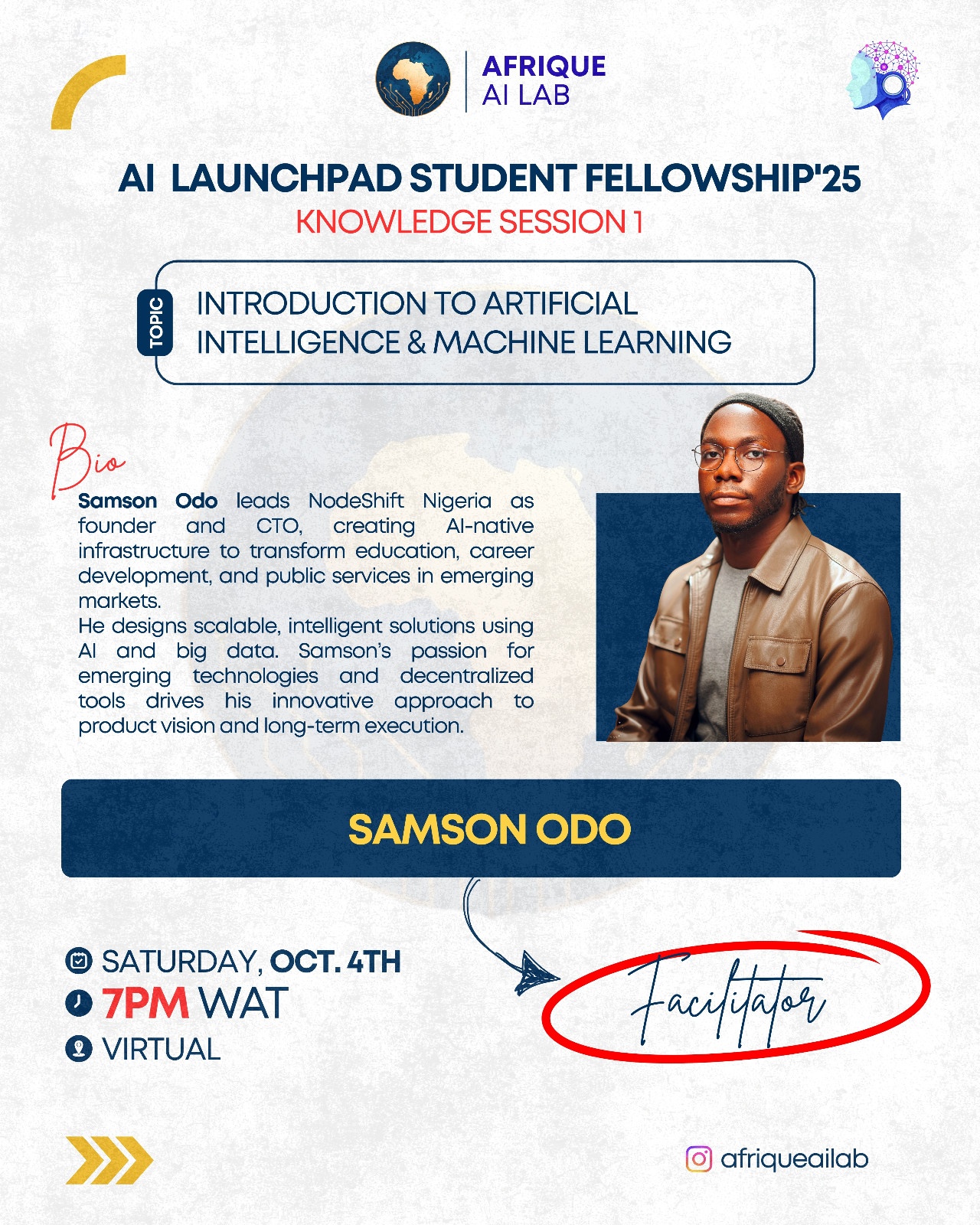
I was invited as a facilitator for the AI Launchpad Student Fellowship 2025, a fully online 8-week program designed to equip Africa’s emerging AI leaders with foundational knowledge, mentorship, and practical experience. From a competitive pool of over 300+ applications, 50 outstanding fellows were selected for this inaugural cohort.
My session, titled Introduction to Artificial Intelligence and Machine Learning, aimed to demystify AI, provide foundational knowledge, and inspire participants to start their AI journeys.
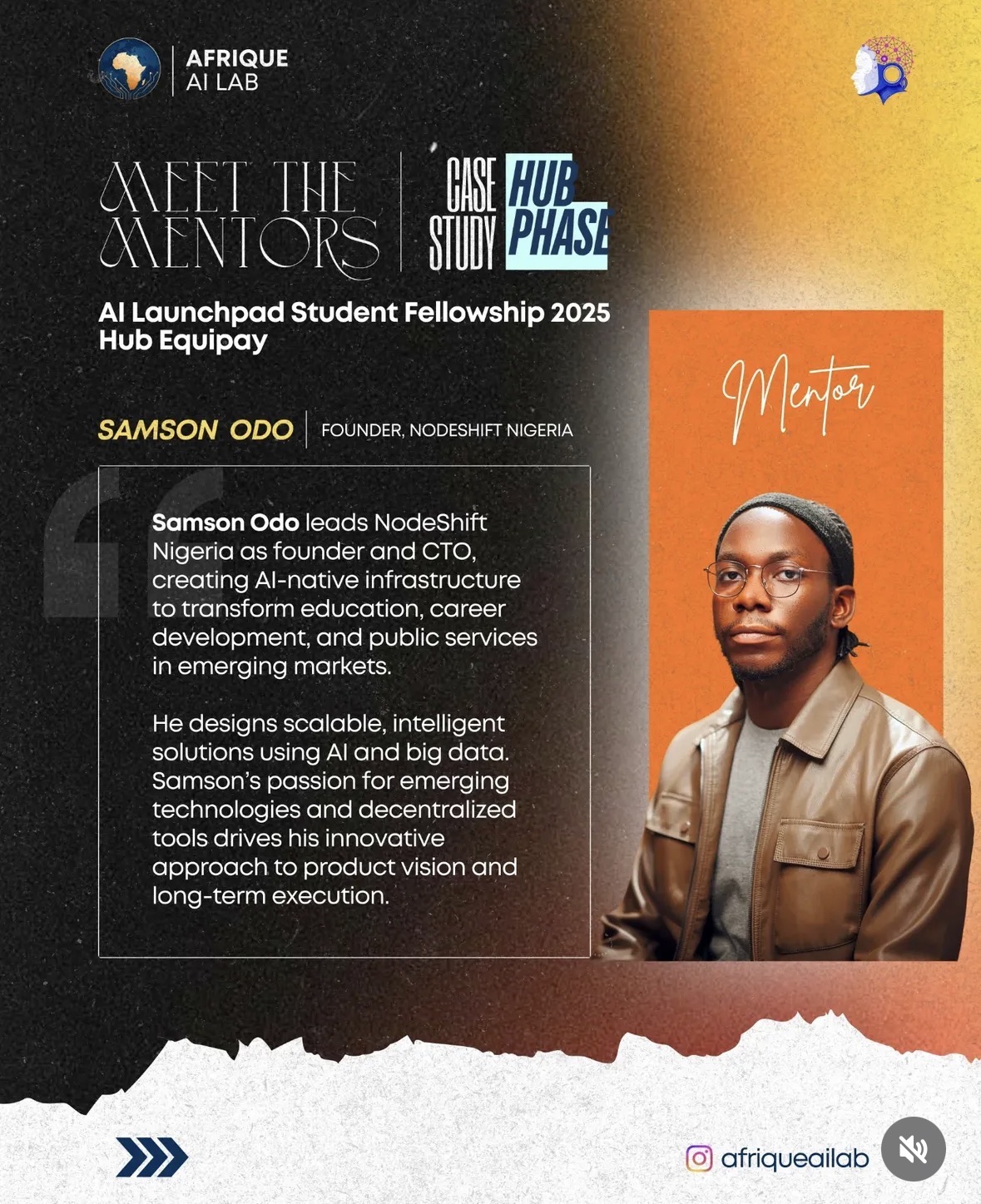
In addition to facilitating this knowledge session, I was also invited to serve as a mentor and review judge for the Case Study Hubs and student projects, providing opportunities for collaborative problem-solving and practical application of learning to enrich the fellows' experience and strengthen the program's impact.
📝 Session Summary
The session began with an overview, quoting Arthur C. Clarke: "Any sufficiently advanced technology is indistinguishable from magic." I explained that while AI like ChatGPT feels magical, it's fundamentally complex mathematics. We interact with AI daily, and it's already shaping our futures.
By the end, participants would gain: a clear understanding of what AI is (and isn't), a simple framework for how it works, and a roadmap for AI's industry transformations and personal journeys. The structure covered breaking down myths, exploring AI's mechanics, the "AI family tree," industry impacts (globally and in Africa), and steps to begin in AI.
If AI has ever seemed confusing, overhyped, or too technical, this session was designed to make it accessible.
Understanding AI: A Historical Perspective
We traced AI's evolution starting from the 1950s with Symbolic AI, inspired by Alan Turing's work—rule-based systems like "If the temperature falls below 20 degrees, turn on the heater."
In the 1980s, Expert Systems emerged as knowledge-based tools mimicking human expertise, such as in medical diagnosis, acting like digital encyclopedias.
The 2000s saw the Machine Learning boom, leveraging faster processors and larger data storage for statistical learning. By the 2010s, Deep Learning revolutionized pattern recognition with neural networks, enabling breakthroughs in computer vision and language processing.
AI is the science of making machines intelligent, augmenting human capabilities through computation—not replacing consciousness.
What AI Actually Is
AI is often hyped with misconceptions of human-like robots, but it's about systems performing tasks requiring human intelligence, like pattern recognition or language understanding, within limited scopes. It's precise pattern recognition imitating intelligence.
Examples: IBM's Deep Blue beat Kasparov in chess in 1997 but couldn't play checkers—illustrating "narrow" AI, brilliant in one area but limited elsewhere.
The AI Family Tree
AI is a family of approaches:
- Symbolic AI (rules): Logic-based, like medical expert systems with IF-THEN rules.
- Machine Learning (data-driven): Learns from examples, e.g., spam filters or Netflix recommendations.
- Deep Learning (neural nets): Mimics brain layers for complex tasks, e.g., Face ID or ChatGPT.
- Computer Vision: For images/videos, e.g., self-driving cars detecting signs.
- Natural Language Processing (NLP): For language, e.g., Google Translate or chatbots.
- Robotics: Controlling physical systems, e.g., Amazon warehouse robots.
Combining these branches unlocks AI's transformative potential in vision, language, decision-making, and movement.
Machine Learning Fundamentals
Machine Learning powers most modern AI. Key concepts:
- Data: Raw information; quality is crucial.
- Model: Mathematical framework capturing patterns.
- Training: Adjusting the model for accuracy.
- Inference: Applying it to new data.
Transforming Industries with AI
AI is reshaping sectors:
- Healthcare: Tumor detection on X-rays; AlphaFold for drug discovery.
- Finance: Fraud detection; credit scoring.
- Agriculture: Drones for crop health; yield predictions.
- Education: Personalized lessons; AI for exam prep.
- Entertainment: Recommendations; AI-assisted music.
- Transportation: Surge pricing; traffic management.
In Africa: Nigerian fintechs for microloans, agri-tech for pest detection, and edtech for adaptive learning—these are real, economy-changing applications.
Next Steps
Africa needs its own AI builders. Essentials:
- Mathematics: Statistics, probability, linear algebra.
- Programming: Python, TensorFlow, PyTorch.
- Projects: Start with Kaggle, GitHub, personal builds.
- Ethics: Focus on fairness, bias, responsibility.
Learn incrementally, build one project, learn by doing. AI won't replace you, but AI-savvy people might. Become a contributor, not just a consumer.
 |  |